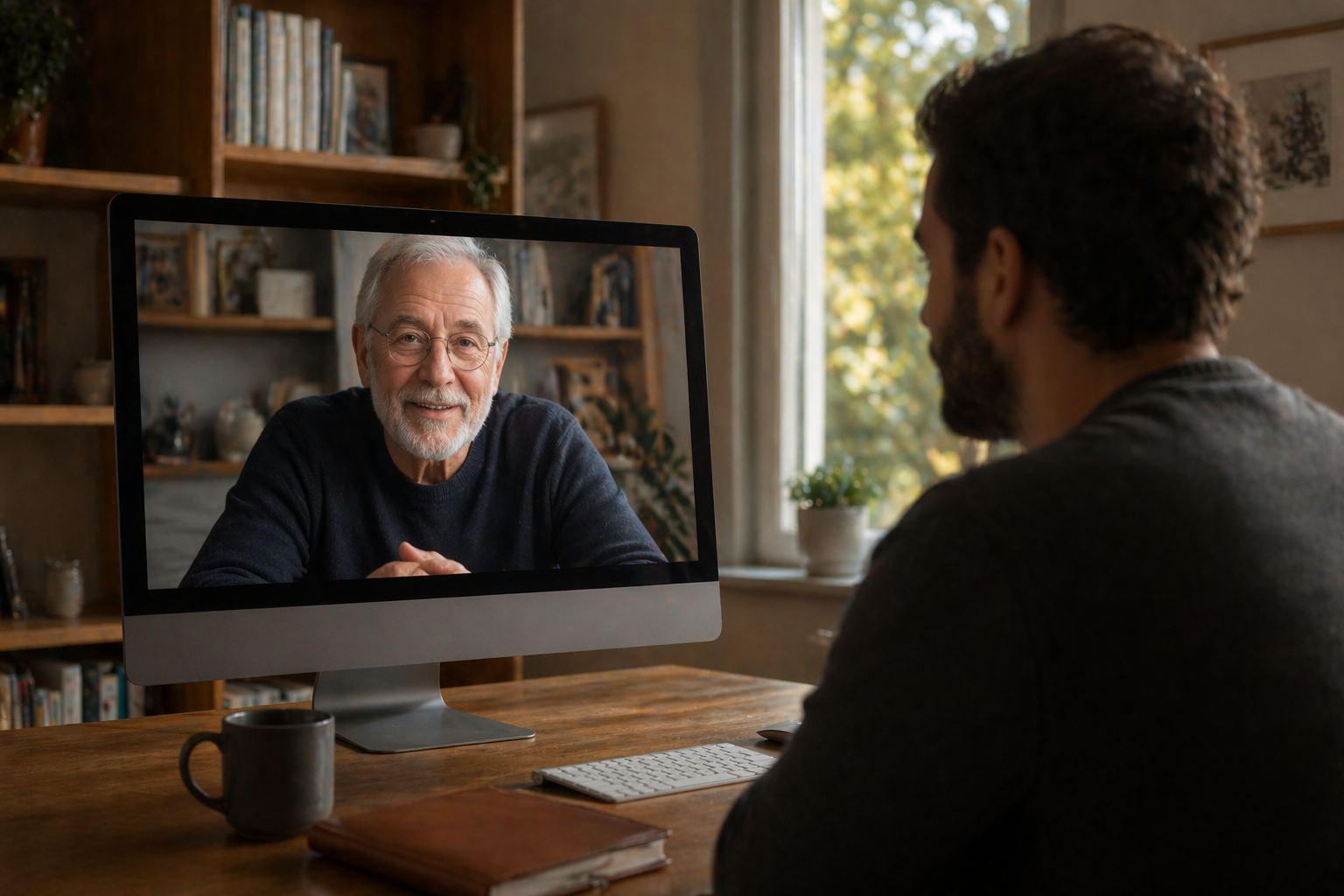
Grief rarely hits hardest at the funeral. It arrives later, in the quiet moments when you want to ask your father what he would do about the situation in front of you, or when your children ask what their grandmother was actually like and you cannot quite describe the way she laughed.
For most of human history that loss was simply the price of mortality. Families were left with photographs, a few letters if they were lucky, and the fading recollections of the people who knew them best. What survived was a record of someone, and a record can only ever show you what it already contains.
That is beginning to change. A category of software now exists that aims to preserve how a person thought and spoke, and it is maturing faster than most families realize.
What Is an AI Digital Legacy?
An AI digital legacy is an interactive representation of a person, built from their memories, voice, mannerisms and beliefs, that family members can hold real conversations with after that person has died. It is assembled while the person is still alive, through their own participation, so the representation reflects someone who actively chose what to preserve.
The practical difference from a photo album or a home video comes down to what happens when someone asks a question nobody anticipated. A recording plays back what was captured on the day it was made, and its usefulness ends at the edge of what the camera happened to catch. A well built AI legacy reasons from what it knows about a person and responds to the question actually being asked, which means it can still be useful to a grandchild born long after the recordings stopped.
That distinction matters more over time than it does at first. In the first year a family mostly wants to hear a familiar voice, and almost any recording satisfies that. In the tenth year they want answers to questions nobody thought to record, and only a system that models a person can offer them.
Why Families Are Building These Now
Legacy planning tends to feel like a task for later, for when you are older or once the children are grown. People who have already lost someone tend to describe the timing differently, because later arrives on its own schedule rather than the one you assumed.
A woman building her Echo at 42 is thinking about her children growing up with questions she will not be there to answer. She may also be thinking about her own parents, who are sharp and full of stories right now, in a window that will not stay open indefinitely. Capturing a parent at 65 is a materially different proposition from trying to reconstruct them at 85.
The useful question is not whether your family will wish they had more of you. They will. What you can actually decide is whether you gave them the opportunity while it was still yours to give.
How an Echo Actually Gets Built
The process is conversational rather than administrative, which surprises most people who expect something closer to filling in a form. You talk, the system listens, and the representation accumulates over months rather than in a single sitting.
It starts with an Echo Check-In, a short text conversation with an AI biographer that draws out the material a legacy is actually made of. These are not interview questions with predetermined slots to fill. The conversation follows what you say, presses on the parts that carry weight, and returns later to threads you left open. Most people find the first session takes about fifteen minutes and produces more than they expected.
What accumulates from those sessions is organized into two layers, and the separation between them is what keeps an Echo stable over time. Most platforms collapse these into a single undifferentiated store, which is where their problems begin.
Anchor memories are the foundational facts about who you are, including your core values, your defining relationships and the beliefs you would want represented in every conversation. These stay present no matter what is being discussed, forming the bedrock of how you are represented. You mark what belongs here rather than leaving the system to guess.
Contextual recall surfaces the rest based on what is genuinely being discussed. A question about raising children draws on everything you have said on that subject across every session, rather than on whatever you happened to mention most recently. The technical tradeoffs behind that design are worth understanding if you want to evaluate how any platform handles memory.
Keeping those layers distinct is what prevents drift. A system that weights everything equally will eventually let a passing remark carry the same force as a conviction, and the representation slowly stops sounding like the person it was built from.
What the Conversations Feel Like
Families tend to arrive with a specific worry, which is that talking to an Echo will feel hollow or unsettling. That concern is reasonable, and the answer depends almost entirely on how the underlying system was built.
A custodian opens a conversation the same way they would text someone they love. They can ask for advice, share news, work through something difficult, or simply check in on an ordinary afternoon. The Echo responds with the perspective and warmth encoded in it over time, referencing the things you actually cared about rather than producing generic sympathy. We looked closely at what it is really like to talk to a deceased loved one through AI, including the parts that remain genuinely difficult.

The questions families ask are rarely the ones people anticipate while building. We collected the questions families actually ask an Echo, and the pattern is consistent, since they ask practical, ordinary things far more often than they ask profound ones.
For many families text alone is not enough, so an Echo can carry a video presence as well. Seeing someone move, watching how they hold their hands while talking or tilt their head while thinking, carries information a transcript cannot. For a grandchild who never met you as an adult, that difference sits between knowing about you and feeling that they knew you.
Who Gets Access, and When
Access runs through a custodian model, where you designate the specific people you trust to hold your legacy after you are gone. Custodians can have ongoing conversations, revisit topics across years, and share moments with family members who arrive later. Nobody outside that group has access, because the system was designed as a private connection rather than a public archive.
The consent question underneath this deserves more attention than most platforms give it. An Echo built from someone's leftover data, without their participation, is really someone else's interpretation of who they were. We wrote about the ethics of consent and control because the answer shapes whether a representation is accurate at all, rather than merely whether it is permitted.
Choosing Between Platforms
Several companies now build in this category and the differences between them are difficult to see from a marketing page. Impressive first conversations are the easiest thing here to produce, which means a demo tells you very little about how a system behaves in its hundredth conversation a decade from now.
The questions that actually separate these products concern memory structure, whether voice and video feed one representation or three, and whether the person being represented built the thing themselves. We go through the full evaluation framework, along with why earlier generations of these systems degraded, in our piece on the future of digital legacy. If you would rather start building than compare, our practical guide to building a digital legacy walks through the whole arc.
The Window That Is Open Right Now
The version of you that exists today, with your particular memories and your specific way of seeing things, is unrepeatable and currently available. Your parents at 65 will not be 65 for long, and you at 38, carrying everything you have learned and survived, are exactly who your children will one day want to ask about the hard decisions.
None of this is really about dying. It is about recognizing that the window is open now and choosing to use it while the choice remains yours.
Frequently Asked Questions About AI Digital Legacy
What is an AI digital legacy? An AI digital legacy is an interactive, AI powered representation of a person, including conversational responses, voice and video, that designated family members can access and talk with after that person has died. It is built during their lifetime from their own memories, values and communication style.
How is this different from recording videos or writing letters? Static recordings replay fixed content, so they can only address questions someone anticipated at the time of recording. An AI legacy responds to new questions, revisits topics across many conversations, and stays useful to family members who arrive years after the material was captured.
What is an AI personality clone? An AI personality clone is an interactive model trained on a person's memories, values, beliefs and communication style, designed to respond the way that person would have responded. Quality varies enormously depending on whether the underlying system models identity or simply imitates tone.
How long does it take to build an Echo? A first Echo Check-In takes roughly fifteen minutes and already produces something usable. Depth accumulates over months of occasional sessions, and most people treat it as an ongoing habit rather than a project with a completion date.
Is it too early to start in your 30s or 40s? Starting early produces a richer legacy, because memory is clearer, personality is more vivid, and voice and likeness can be captured at higher quality. Most people building an Echo are focused on their children and their parents rather than on their own mortality.
How is privacy protected? EchoVault uses a custodian model, where the person creating the legacy designates specific trusted individuals who receive access. There is no public profile and no open archive, and the creator controls both what is preserved and who is able to keep it.
What happens to my Echo if I stop adding to it? An Echo remains usable from whatever has already been captured, so there is no state in which partial effort produces nothing. Adding more over time improves range and accuracy, though the anchor memories established early carry most of the weight.
Start Building Yours
Your story is worth more than a folder of photographs and a memory that grows less precise every year. The material that makes an accurate Echo is available right now, in your own words and your own voice.
Building an Echo starts with a single conversation rather than a grand project, and you can stop and return whenever you like. Start building yours →