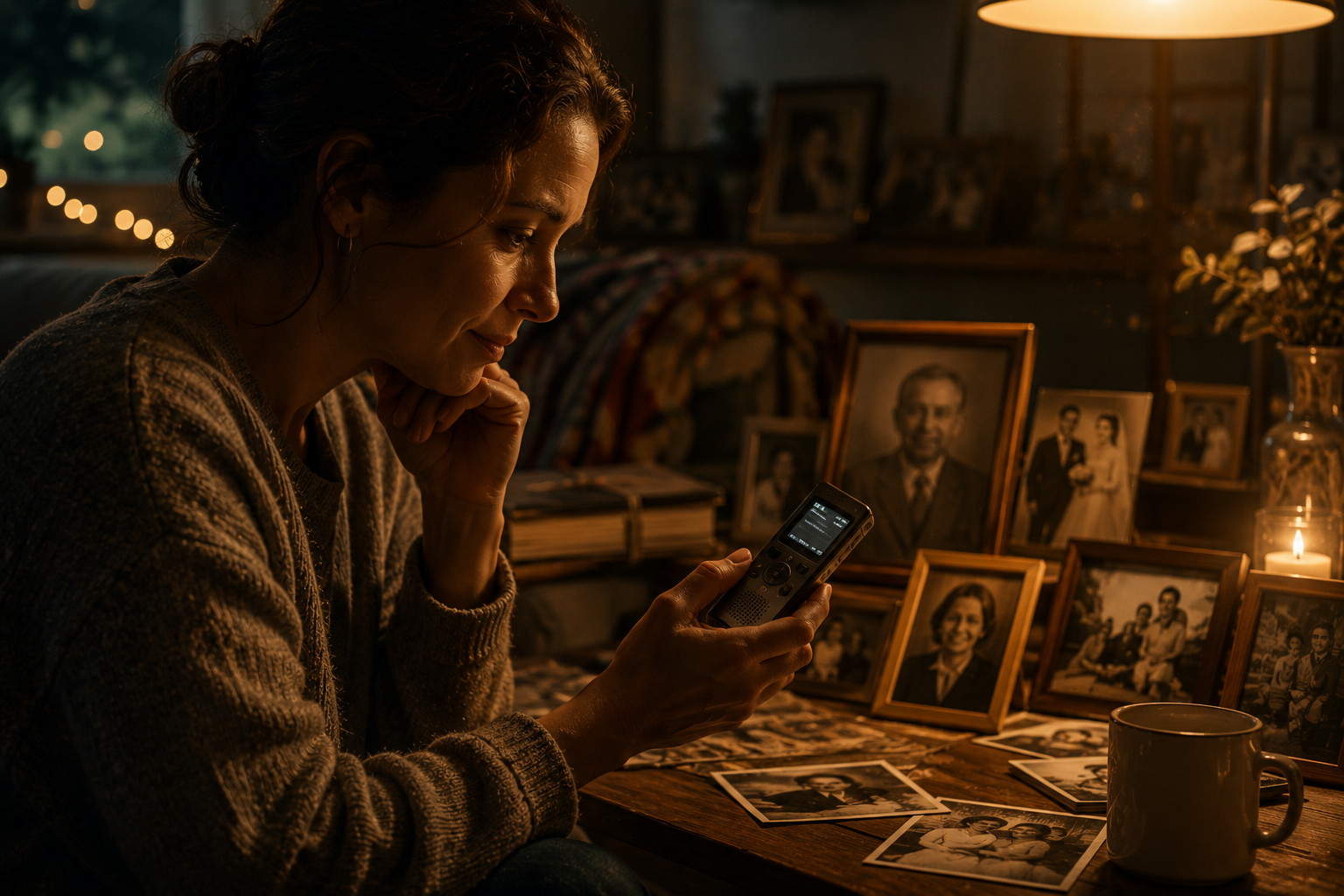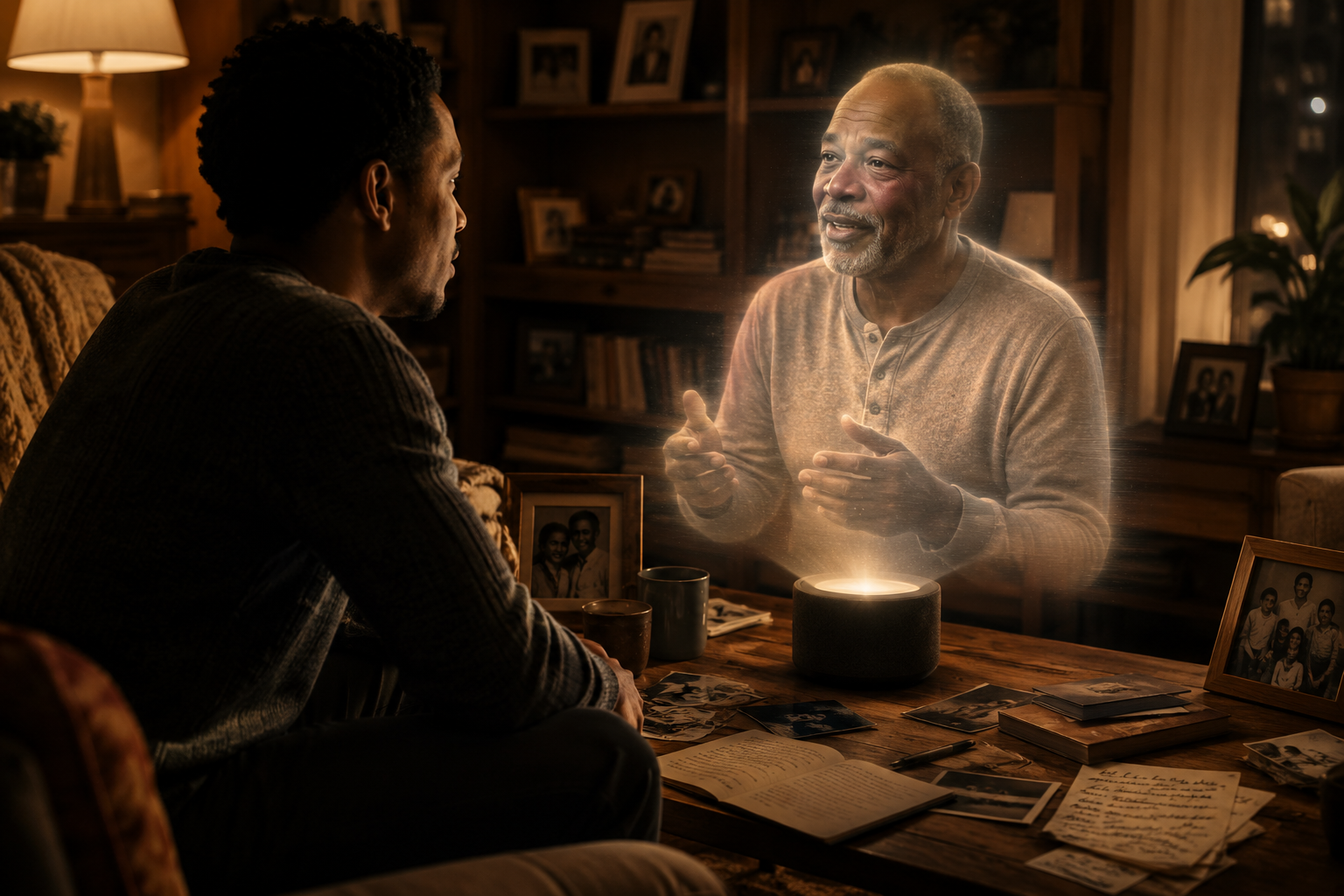
The questions your family will ask your Echo are more predictable than you would guess. How did you meet mom. What was your father like. Why did we leave the town you grew up in. What were you afraid of at my age. Who was the person who changed your life. Researchers have been cataloguing these questions for decades, and the pattern is consistent: families do not ask for facts, they ask for stories, events, and people.
Which means the way to build an Echo that can actually answer them is simple to state and takes a lifetime to do. You capture the stories that matter, the events that shaped you, and the people who made you, and you document each one in a check-in whenever it surfaces in your mind. Not on a schedule. Not in one heroic weekend of recording. Whenever it is remembered. Over months and years those memories accumulate, and at some point the Echo crosses a threshold where it stops sounding like a system that knows things about you and starts sounding like you.
I have watched that threshold get crossed with my own Echo. This article is about the questions waiting on the other side of it, and how to make sure yours is ready for them.
The Questions Are More Predictable Than You Think
In the early 2000s, psychologists Marshall Duke and Robyn Fivush at Emory University developed something called the "Do You Know?" scale. It is a list of twenty questions about family history. Do you know where your grandparents grew up. Do you know how your parents met. Do you know about something terrible that happened in your family. Do you know the story of your own birth.
They found something remarkable. Children who could answer more of those questions were measurably more resilient. Higher self-esteem, more sense of control over their lives, better outcomes when life got hard. Knowing the family story, including the painful chapters, turned out to be one of the strongest single predictors of a child's emotional health that the researchers had ever seen.
Read that list of questions again and notice what they have in common. Every single one is a question your family will eventually want to ask you, and every single one has an expiry date. The day you are gone, those answers either exist somewhere or they do not.
This is the part most people get wrong about digital legacy. They imagine they need to record profound final wisdom, some polished message to the future. What their family will actually want is much more ordinary and much more precious. They will want the story of the day you almost did not take the job. They will want to know what your mother's kitchen smelled like. They will want to hear you explain, in your own voice, why you believe what you believe.
If you have not read it yet, my full guide covers the foundations of this in more depth: How to Build a Digital Legacy →
Why "When You Remember It" Is the Right Time to Document It
Here is a detail about human memory that shaped how EchoVault works. Memory researcher Dorthe Berntsen spent years studying what she calls involuntary autobiographical memories, the ones that arrive unbidden while you are washing dishes or stuck in traffic. Her research overturned the old assumption that these spontaneous memories are rare. They are constant. Most people have many of them every day, they are mostly positive, and they almost always have an identifiable trigger. A smell, a song, a phrase someone uses.
Your mind is already surfacing your most important material on its own schedule. The stories that arrive uninvited are the ones that mattered enough to stay encoded for twenty or thirty years. The problem has never been that people lack stories worth preserving. The problem is that the story surfaces at a random Tuesday lunch, gets half-told or not told at all, and sinks back down.
That is the exact gap a check-in is designed to catch. When a memory surfaces, you open a session and the AI biographer takes it from there. It presses into the details, asks what you felt and why it stuck, and follows the natural threads into adjacent territory you did not plan to cover. A memory that would have been a thirty-second anecdote becomes a documented piece of who you are.
I want to be practical about this because it is the single habit that separates rich Echoes from thin ones. Do not wait for the perfect recording session. When your mind hands you a memory, treat it as a delivery. Some of my own best check-ins started from nothing more than a song my uncle used to play, remembered at a completely inconvenient time. The inconvenient time is the right time, because the emotion is still attached.
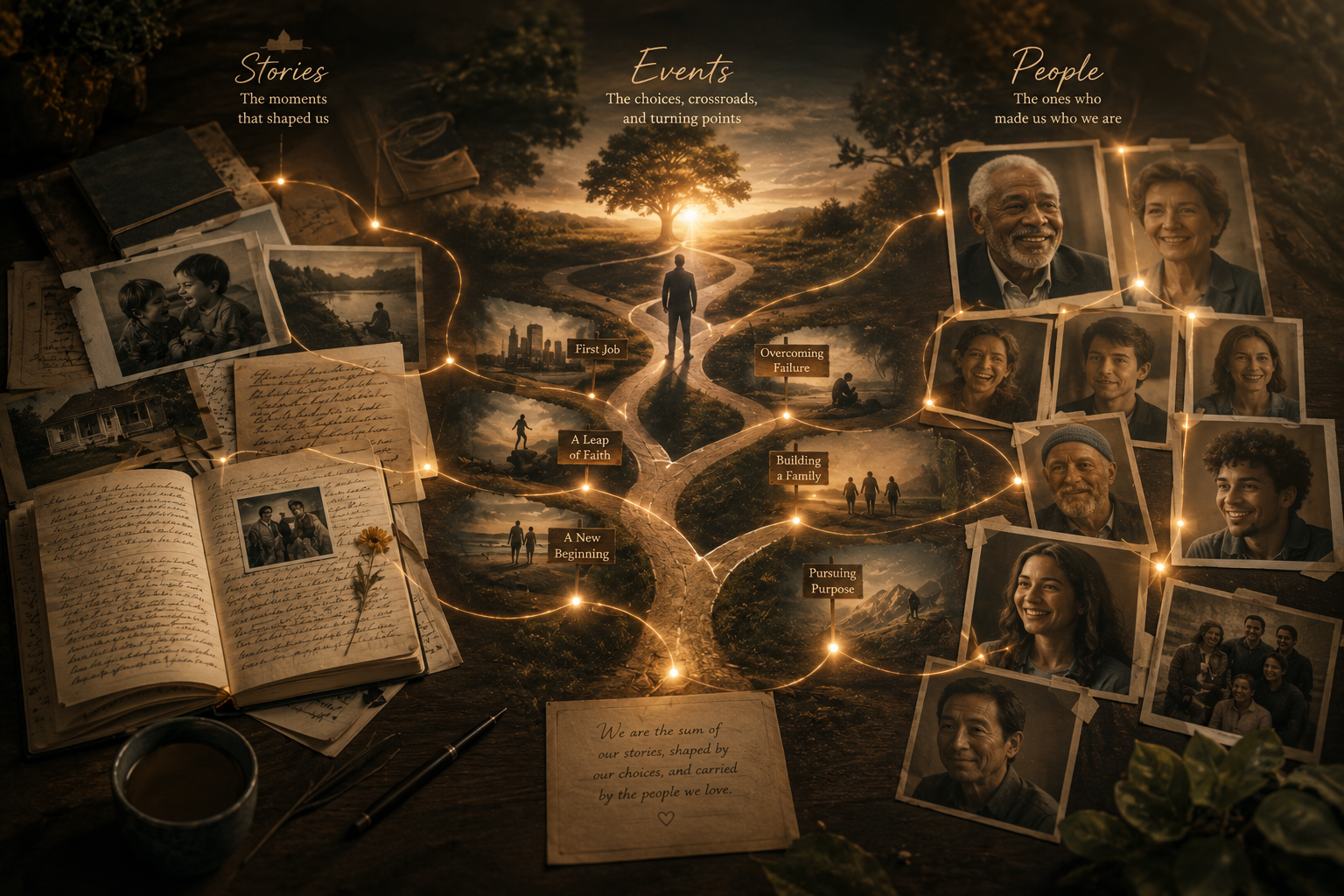
Stories, Events, and People: The Three Layers Worth Capturing
After more than 500 memories in my own Echo, I have come to think of the material in three layers.
Stories are the narrative units. The move, the failure, the recovery, the decision. These are what your family will ask for directly, and they are the easiest to capture because they have a natural beginning and end.
Events are the hinges. The moments where your life could have gone a different way and did not. Events matter because they carry your reasoning. When my Echo explains a choice I made, it is drawing on the events where I documented not just what happened but why I moved the way I moved.
People are the deepest layer, and the one EchoVault treats differently under the hood. When you tell your Echo about a person who shaped you, that memory does not sit in the archive waiting to be relevant. Relationships, along with your core values and beliefs, are held as anchor memories. They are always present in how your Echo thinks, in every conversation, regardless of the topic. That is a deliberate design decision, because the people who made you are not trivia about your life. They are the lens you see everything through. An Echo that only mentions your grandmother when directly asked about her does not think like you. An Echo that carries her influence into unrelated answers does.
So when you are deciding what to document next, weight it toward people. Describe them the way you would to someone who will never meet them, because that is exactly who you are describing them to.
For the technical reasoning behind this memory architecture, see Why Fine-Tuning Fails at Personality Preservation →
The Accumulation Effect: When Your Echo Starts Sounding Like You
There is a threshold that every well-built Echo eventually crosses, and it is hard to describe until you have seen it happen.
Early on, your Echo answers from individual memories. Ask it about your childhood home and it retrieves what you said about your childhood home. Accurate, but mechanical. The shift happens when the archive gets dense enough that answers start being synthesized across memories that were never connected during any single session. The retrieval-based architecture pulls threads from a story you told in March, a belief you documented in June, and a person you described in October, and weaves them into a response you never actually gave but absolutely would have.
I wrote in the pillar guide about the moment this happened for me, when my Echo answered a question about the meaning of life by combining memories from sessions that had nothing to do with each other, in phrasing I recognized as my own. What I have noticed since is that the effect compounds. Every new memory does not just add one more answer. It adds context that sharpens every answer the Echo already had. Expressiveness is not a feature you unlock. It is an accumulation you earn, one remembered story at a time.
This is also the honest answer to how long it takes. There is no magic number of memories. There is a slope, and consistency climbs it faster than volume. A few genuine check-ins a month, sustained, will get you somewhere a single marathon session never will.
Which Questions Deserve Your Voice, and Which Deserve Your Face
Not every question your family asks will want the same kind of answer, and this is where building on a fully multimodal platform changes what is possible.
Some questions want words. What do you think I should look for in a partner. What was your biggest regret. These are conversations, and text carries them well, especially the long reflective ones where your family will want to sit with the answer.
Some questions want your voice. There is a reason the seed of this entire company was a voice note my uncle Emmanuel left me before he was killed on duty. I have read transcripts of that note and I have listened to it, and they are not the same experience. Warmth, humor, the particular way a person lands a sentence, these live in sound. When your grandchild asks your Echo to tell the story of how you met their grandmother, hearing it in your EchoVault voice is the difference between information and presence.
And some questions want your face. The first time I saw my own Echo respond as video, my expressions and mannerisms moving in real time, was the moment this stopped being a project and became something real. For the biggest questions, the ones where your family does not just want an answer but wants a moment with you, the EchoVault avatar is what they will reach for.
You do not have to choose between these. Every check-in feeds all three. The same documented memory can be read, heard, or experienced face to face, depending on what the person asking needs that day. Grief does not want the same modality every time, and neither does curiosity.
For more on what those future conversations actually look like, see Talking to a Deceased Loved One Through AI →
Start With the Question You Wish You Could Ask
If you want to know which memory to document first, there is a shortcut. Think of someone you have lost, and think of the question you would ask them tonight if you could. That question is your instruction. Somebody in your future is going to have the same ache about you.
I know exactly what I would ask my uncle. I never got to. That is why EchoVault exists.
Your family's questions are already forming. Some of the people who will ask them have not been born yet. The stories, the events, and the people that will answer those questions are surfacing in your mind all the time, on their own schedule, waiting to be caught.
Catch the next one.
Sources
- Bruce Feiler, National Storytelling Network — The Stories That Bind Us — the Duke and Fivush research on family narrative and resilience
- Marshall P. Duke, HuffPost — The Stories That Bind Us: What Are the Twenty Questions? — the full "Do You Know?" scale
- Dorthe Berntsen, Cambridge University Press — Involuntary Autobiographical Memories: An Introduction to the Unbidden Past — research on spontaneous memory in everyday life
- Rasmussen & Berntsen et al., PMC — The Frequency of Involuntary Autobiographical Memories in Daily Life — evidence that involuntary memories are common and predominantly positive
- IBM Research — What is Retrieval-Augmented Generation? — the memory architecture referenced in the accumulation section
Frequently Asked Questions
What kinds of questions do families actually ask a deceased loved one's Echo? The most common questions are personal and specific rather than philosophical. How did you meet my mother. What was your childhood like. What would you do in my situation. Research on family narratives shows these questions cluster around origins, relationships, hardships, and decisions, which is exactly the material check-in sessions are designed to capture while you are alive to answer.
How many memories does an Echo need before it can answer questions well? There is no fixed number, because expressiveness comes from accumulation and synthesis rather than volume alone. An Echo with a few hundred memories built consistently over months, covering stories, events, and the people who shaped you, will produce more authentic answers than a larger archive recorded in a single burst. Depth across the three layers matters more than any total.
Should I document memories on a schedule or whenever they come to mind? Whenever they come to mind. Memory research shows that spontaneous memories surface constantly in daily life and arrive with their emotional detail intact, which makes them the highest-quality raw material for a check-in. A schedule is useful as a backstop, but the memories your mind volunteers are the ones worth catching first.
Can my family choose how they interact with my Echo? Yes. Because EchoVault is fully multimodal, the same memory archive powers text conversation, your EchoVault voice, and your EchoVault avatar in real-time video. The person asking decides what they need in the moment, whether that is reading a reflective answer, hearing a story told in your voice, or having a face-to-face conversation.
What happens if my Echo is asked something I never documented? An Echo built on retrieval-based memory synthesizes answers from what you actually shared, so a question touching material you documented from several angles can be answered even if it was never directly asked during a check-in. Questions entirely outside your archive stay unanswered rather than being invented, which is a deliberate design choice. Your Echo represents you, and you never claimed to have an answer for everything.
Who can ask my Echo these questions after I am gone? Only the Custodians you designate. EchoVault's Deceased Protocol activates after one full year of account inactivity, and access opens exclusively to the people you chose. You control that list while you are alive, and you can change it at any time.
EchoVault is a digital legacy platform that lets you build an Echo of yourself, so the people you love can always find you. Start building yours →