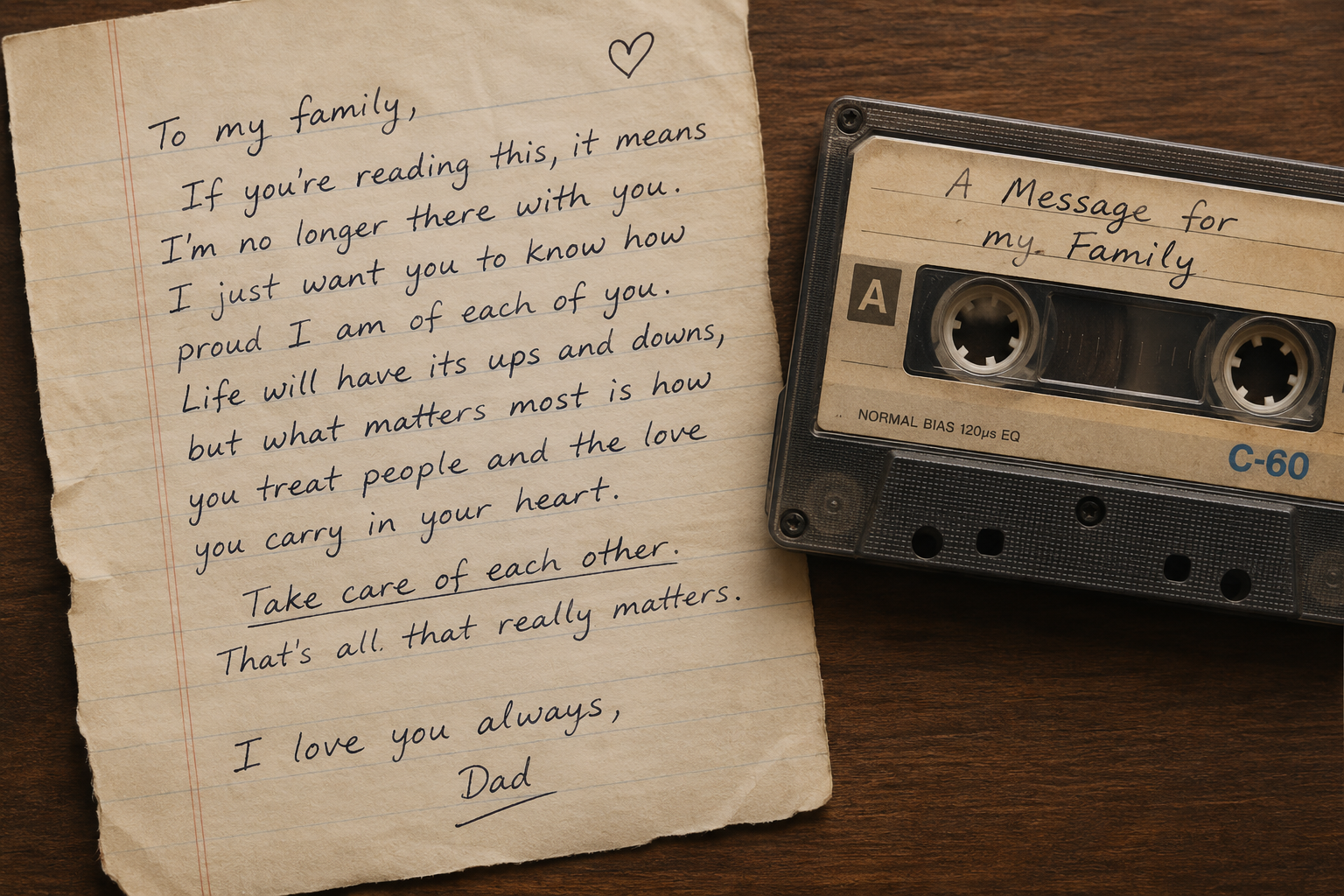
Most estate planning conversations start and end with money. Who gets the house, how the accounts get split, what happens to the business. It's the part that shows up in legal documents, so it's the part that gets planned for.
But ask anyone a year or two after they lost someone what they actually miss, and money rarely comes up. They miss the way that person laughed at their own jokes before anyone else did. They miss being able to call and ask "what would you do here." They miss small, specific things that no will was ever going to capture.
If you're thinking about what to leave behind, here's the case for planning for more than the financial part.
The lessons that outlast the inheritance
Money gets spent, invested, or divided within a generation or two, and the numbers back this up more than people expect. A widely cited 20-year study of more than 3,000 wealthy families found that about 70% lose their wealth by the second generation, and roughly 90% by the third, regardless of how much there was to begin with.
What tends to last longer is harder to put a number on. The way someone handled conflict. What they refused to compromise on. The specific advice they gave at the exact moment you needed it.
These lessons rarely get written down because they don't feel like "content" while they're happening. They show up in passing, in a comment after dinner or a story told for the third time. If nobody captures them, they get summarized into something vague, like "Grandpa was a hard worker," instead of staying specific, like the actual story about the winter he kept the shop open through.
The fix isn't complicated. It's deciding, ahead of time, that these moments are worth writing down or recording when they happen, instead of trusting that you'll remember the details later.
The voice fades faster than the memory
People underestimate how quickly the sound of someone's voice becomes hard to recall. You can usually remember that someone existed, what they looked like, even specific things they said. What goes first is the cadence: how fast they talked, where they paused, the exact phrase they used instead of the one you'd expect.
This isn't just a sentimental observation, and it isn't rare. A 2022 YouGov survey of more than 6,000 Americans found that only about a third of people had ever recorded or documented a conversation with someone close to them, while nearly half said they regretted not doing so with someone who had since died. Among people who had recorded something, the regret rate over what they hadn't captured was even higher.
If there's one thing worth recording on purpose, it's a person actually talking. Not a formal interview. The ordinary version: explaining how they make their coffee, telling a story you've heard before, complaining about something minor. That's the version that actually sounds like them years later.
Specific stories beat highlight reels
There's a difference between "she was always there for us" and the specific Tuesday she drove four hours because you called crying about something that, in hindsight, wasn't that serious. The first is a summary. The second is a memory you can actually return to.
This tracks with how memory researchers describe the difference between specific and "overgeneral" recall. Reviews of autobiographical memory research describe a common pattern where people default to broad, summarized versions of the past rather than single, detailed events, and that pattern tends to crowd out the specific version over time. Separately, work on memory and identity suggests that the ability to recall specific, distinguishing memories is closely tied to having a clear, stable sense of who someone was, not just what they did.
Families tend to default to the summary version when they talk about someone, especially after they're gone. It's faster to say, and it's not wrong, but it's also not what anyone is actually trying to hold onto. The specific version, the one with a place, a time, and an exact thing someone said, is the one that still feels like them.
If you're thinking about what to leave behind, specific stories are worth more than a polished list of accomplishments. A messy, ordinary memory with real detail will outlast a tidy one every time.
What to actually do about it
None of this requires a major project. It requires deciding that values, voice, and specific memories are worth capturing the same way you'd capture a financial account, on purpose, before you need to.
A few starting points:
- Write down or record a story the next time it comes up naturally, instead of waiting for a planned moment.
- Ask the people in your life what they'd want their kids to know, not just what they want them to have.
- Capture voice on purpose. A short recording of someone talking normally is worth more later than people expect.
- Don't wait for a milestone. The ordinary Tuesday is usually more representative than the big anniversary.
This is part of why EchoVault is built around regular, low-effort Check-Ins instead of a single big recording session. Capturing a life in one sitting puts pressure on the wrong moments. Capturing it in small, ordinary pieces over time looks a lot more like how people actually remember each other.
→ How to Build a Digital Legacy: the full process, from deciding what to capture to making sure it actually reaches the people you want it to.
FAQ
What does "leaving a legacy" mean besides money? It usually means the things that don't fit in a will: values and life lessons, the specific way someone spoke or laughed, ordinary stories, and practical advice for moments their family will face after they're gone.
How do I preserve someone's voice, not just photos or videos? Record them talking normally, not in a formal interview. A short clip of someone explaining a recipe or telling a familiar story captures cadence and word choice in a way photos can't.
What's the difference between a specific memory and a general one? A general memory is a summary, like "she was always supportive." A specific memory has a place, a time, and a detail you can return to, like the exact thing she said the night before a big decision. Specific memories tend to last longer and feel more like the person.
Do I need a big project to start documenting this? No. Most of this gets lost simply because nobody decided in advance that it was worth capturing. Recording or writing down a story the moment it comes up, rather than waiting for a "real" occasion, is enough to start.
How does EchoVault help with this? EchoVault is built around small, regular Check-Ins rather than one long recording session, so values, voice, and specific memories get captured the way people actually share them, over time and in ordinary moments.
Ready to start capturing more than the financial part of your legacy? Start your Echo at app.echovault.me